Pharmaceutical manufacturing places exceptional demands on every piece of equipment in the facility. Raw materials arriving as liquids, powders or granules in steel drums, plastic containers or fibre barrels must be moved safely, traceably and without any risk of contamination or damage. The forklift truck attachment used to handle those drums is as much a part of that controlled environment as the processing equipment inside them.
St Clare Engineering supplies Grab-O-Matic drum handling forklift attachments to pharmaceutical manufacturers, API producers and chemical distributors operating under Good Manufacturing Practice (GMP). This guide explains what pharmaceutical operations need from drum handling equipment, how GMP requirements apply, and how the Grab-O-Matic range is used in practice across the sector.
Why drum handling matters in pharmaceutical manufacturing
Drums and intermediate bulk containers are the most common format for receiving and transferring pharmaceutical raw materials. Active Pharmaceutical Ingredients (APIs), excipients, solvents, reagents and packaging materials all arrive in drums at some point in the manufacturing process. In a GMP-regulated facility, every step in the handling of those materials is subject to documentation, risk assessment and control.
That creates specific requirements for the equipment used to move drums. A standard warehouse drum handler is not necessarily appropriate in a pharmaceutical environment. The surface finish, material of construction, cleanability, and the risk of contamination transfer between drums are all factors that need to be considered when specifying handling equipment.
Inadequate controls over drum handling and the reuse of drums between different product streams has been cited in drug contamination events and regulatory enforcement actions. The MHRA Inspectorate has identified cross-contamination control as a recurring focus of GMP inspections, with regulatory action required at sites where controls were found to be insufficient.
GMP requirements relevant to drum handling equipment
The MHRA enforces Good Manufacturing Practice in the UK under a framework aligned with international standards including EU GMP, PIC/S, and ICH Q7 for Active Pharmaceutical Ingredients. The MHRA Orange Guide (Rules and Guidance for Pharmaceutical Manufacturers and Distributors) is the definitive reference for UK manufacturers.
While GMP guidance does not specify forklift attachment types, several principles apply directly to drum handling equipment:
Equipment must be suitable for its intended purpose
Equipment used in or adjacent to pharmaceutical manufacturing must be appropriate for the task, easy to clean, and constructed from materials that will not contaminate the product or react adversely with cleaning agents.
In practice, this means stainless steel is strongly preferred over painted mild steel in areas where drums containing pharmaceutical materials are handled, particularly where spillage is possible or where the equipment may come into contact with drum surfaces.
Cross-contamination must be prevented
EU GMP Chapter 5 and MHRA Inspectorate guidance on cross-contamination control require manufacturers to identify and control all potential routes of cross-contamination in shared facilities. A forklift drum attachment used across multiple product areas, or used with drums containing different materials, is a potential cross-contamination route if it is not properly cleaned between uses and if contamination transfer via the drum exterior is not assessed.
Equipment must be maintainable and inspectable
GMP requires that manufacturing equipment is maintained in a good state of repair and that maintenance does not introduce contamination risk. For drum handling forklift attachments, this means annual LOLER-compliant servicing and thorough examination, with records retained. The design of the attachment should facilitate cleaning and inspection: crevices, unsealed welds and inaccessible surfaces are potential harbourage points that can complicate cleaning validation.
Materials must be handled without damage or mix-up
Drum integrity is a GMP concern. A damaged drum can compromise the identity, purity or quantity of the material inside. The wrong drum lifted or transported to the wrong location is a material mix-up. Drum handling equipment must grip reliably and consistently, without the risk of dropping or damaging the drum, and the handling process should support the site's material segregation and identification controls.
Drum types used in pharmaceutical manufacturing
Pharmaceutical raw materials arrive in a range of drum and container formats, each with different handling requirements. Understanding the drum type is the starting point for specifying the right attachment.
Steel drums
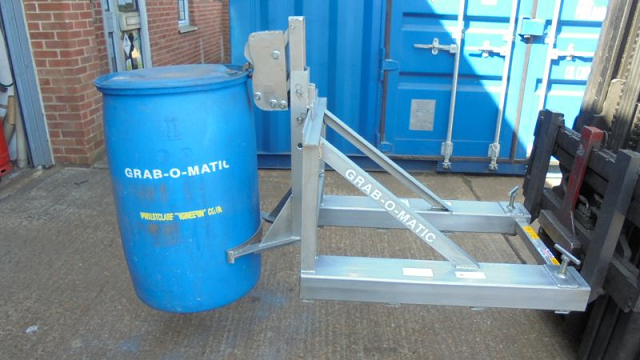
Stainless steel and mild steel drums are the standard format for pharmaceutical solvents, liquid APIs, liquid excipients and chemical reagents. They are robust, resealable and compatible with a wide range of chemical contents. Rim grippers and waist grippers are both well suited to steel drums, with the choice depending on the drum's geometry and the presence of a pronounced rolling rim. Where controlled pouring or emptying is required, drum rotators allow the drum to be tilted or rotated for dispensing without operator contact with the contents.
Plastic drums and IBCs
High-density polyethylene (HDPE) and other plastic drums are widely used for aqueous solutions, liquid excipients and lower-hazard materials. Plastic L-ring drums require an attachment compatible with the L-shaped rim profile. St Clare Engineering's plastic drum handling range includes dedicated L-ring attachments and waist grip options suitable for the range of plastic drum formats used in pharmaceutical operations.
Fibre drums
Dry APIs, powdered excipients, granules and packaging materials commonly arrive in fibre drums: cylindrical containers made from cardboard, Kraft paper or fibreboard, sometimes with metal rims or plastic lids. Fibre drums require careful handling as the material is more susceptible to damage than steel or plastic. The shape, laden weight and construction of the drum determine which gripping head is appropriate. Standard drum handling attachments are not always suitable for fibre drums and specialist gripping heads such as the Grabo-O-Matic Twin Head should be specified.
Mauser and UN-approved drums
Mauser drums and other UN-approved composite intermediate bulk containers are used for hazardous pharmaceutical materials where specific packaging requirements apply. Dedicated Mauser drum attachments in rim grip or base gripping configurations are available from St Clare Engineering for operations handling this format.
What happens if you choose the wrong grip for your drum?
Choosing the wrong attachment for a given drum type is one of the most common causes of drum damage in industrial handling operations. A forklift truck attachment grip that is too aggressive, incorrectly positioned or incompatible with the drum's construction can dent, deform or puncture the drum, compromise the seal, or dislodge the labelling. In a standard warehouse environment that means product loss and a damaged container. In a pharmaceutical manufacturing facility operating under GMP, the consequences are more serious: a damaged drum may trigger a material deviation, require investigation and documentation, and result in a compromised batch, a quality hold or a regulatory notification to the MHRA.
Fibre drums are particularly vulnerable. The relatively lightweight material offers less resistance to gripping force than steel or plastic, and a standard attachment applying pressure at the wrong point can crush or deform the drum body, breaking the seal and exposing the contents. Getting the attachment specification right for each drum type and weight in a regulated manufacturing environment is part of the contamination and quality risk management process.
St Clare Engineering's team can advise on the correct attachment for your drum type, weight and handling environment before you purchase or hire. A short conversation at the specification stage is considerably less costly than a deviation investigation after the event.
ATEX requirements in pharmaceutical environments
Solvent handling is a feature of most pharmaceutical manufacturing operations, and solvents create potentially explosive atmospheres. Where drums containing flammable liquids are handled in enclosed or poorly ventilated areas, ATEX classification applies under the Dangerous Substances and Explosive Atmospheres Regulations (DSEAR).
St Clare Engineering's ATEX-rated stainless steel drum handling range is specifically designed for Zone 1 and Zone 2 hazardous area classifications. Because the attachments are entirely mechanical, with no electrical components and no hydraulic fluid, they present no ignition source and are inherently compatible with explosive atmosphere requirements. The stainless steel construction also meets the hygiene and cleanability requirements of pharmaceutical environments.
The chemical processing sector uses similar ATEX-rated handling equipment. St Clare's chemical drum handling guide provides further detail on ATEX requirements that is also applicable to pharmaceutical solvent handling.
Stainless steel construction in pharmaceutical environments
The standard Grab-O-Matic drum handling range is manufactured from mild steel with a high-quality painted finish. For pharmaceutical environments and other applications where hygiene, corrosion resistance or compatibility with cleaning agents is a requirement, stainless steel construction is available across the range.
Stainless steel construction offers several practical advantages in pharmaceutical drum handling:
• Resistance to corrosion from cleaning agents, including alkaline detergents and acidic sanitisers commonly used in pharmaceutical facilities
• Smooth, limited-crevice surfaces that are easier to clean and less likely to harbour contamination between product campaigns
• Compatibility with wash-down procedures where the attachment may be wetted during cleaning of the surrounding area
• Reduced risk of particulate contamination from paint flaking or surface degradation in areas where drum exteriors may contact the gripping heads
St Clare Engineering has supplied bespoke stainless steel drum handling solutions to pharmaceutical customers, including a bespoke ATEX stainless steel twin-head double drum handler developed for a customer with specific clean-area and explosive atmosphere requirements. Bespoke configurations are available for operations whose drum format, weight or environmental requirements fall outside the standard range
LOLER compliance in pharmaceutical operations
The same LOLER obligations that apply to drum handling equipment in any industrial setting apply equally in pharmaceutical manufacturing. Forklift drum attachments must be thoroughly examined by a competent person at least every 12 months, with written reports retained. Full details are covered in St Clare Engineering's LOLER guide for drum handling equipment.
In a GMP environment, LOLER records sit alongside other equipment qualification and maintenance documentation. Quality Assurance teams should ensure that drum handling attachments are included in the site's equipment register, that LOLER examination reports are filed with maintenance records, and that any defects identified are addressed within the timescale specified in the examination report.
St Clare Engineering's annual service and inspection programme provides collect-and-return servicing with a written service record for each visit. Loan units are available to UK customers during the service period to avoid disruption to production schedules.
The Grab-O-Matic range in pharmaceutical use
St Clare Engineering supplies drum handling forklift attachments to pharmaceutical manufacturers, API producers and pharmaceutical chemical distributors. Customers in this sector include Banner Chemicals, Carbogen Amcis, Dr Reddy's Laboratories and Pharmacosmos.
The attachments used most frequently in pharmaceutical environments are:
• Stainless steel rim grippers for steel drum handling in solvent and API areas
• ATEX-rated stainless steel drum handlers for solvent handling in hazardous area classifications
• Drum rotators for controlled dispensing and emptying of liquid raw materials
• Specialist attachments for fibre drums and plastic drums used for dry APIs and excipients
• Bespoke configurations for non-standard drum formats or specific clean area requirements.
All attachments are supplied with proof-load test certificates and Safe Working Load markings as standard. CE and UKCA certification is included. ATEX certification is provided for the stainless steel ATEX range.
Specifying drum handling equipment for a pharmaceutical site
Selecting the right attachment for a pharmaceutical operation requires a clear understanding of the drum types in use, the weights involved, the environmental classification of the handling area, and the cleaning regime the attachment will be subjected to. St Clare Engineering's team can advise on product selection and, where the standard range does not meet the requirement, develop a bespoke solution. Our Ultimate Guide to choosing the right drum handling attachment provides a full product selection framework.