This challenges long held assumptions about metallic sealing ring performance in valves that must withstand high temperatures beyond the limits of polymer seals.
While metallic rings have been essential in high temperature environments for decades, the industry has accepted that they leak more than polymer alternatives. The new data illustrates that geometry—not just material—can be the key to unlocking better sealing performance.
In an extensive test programme, engineers at Cross Manufacturing used a purpose built 2.5 inch modular test rig to compare the leakage characteristics of different metallic ring designs used in cage guided globe valves and similar systems. The study put four gap configurations head to head—along with variations in ring width, ring packs and surface finish—to determine which variables genuinely influence leakage and which have only marginal impact.
Results show that a pair of side cut step gap rings almost eliminated direct leakage paths, achieving performance roughly twenty-five times better than the standard butt gap ring configuration widely used in high temperature valves today. In international terms, the pair met ANSI FCI 70 2 Class IV leakage levels, a benchmark many valve makers aim for but struggle to achieve with metallic seals.
A second configuration—a scarf cut step gap ring—also delivered strong results, achieving Class IV performance when paired with finer surface finishes. For applications where groove width limits the use of dual ring arrangements, the test suggests this could represent a meaningful improvement.
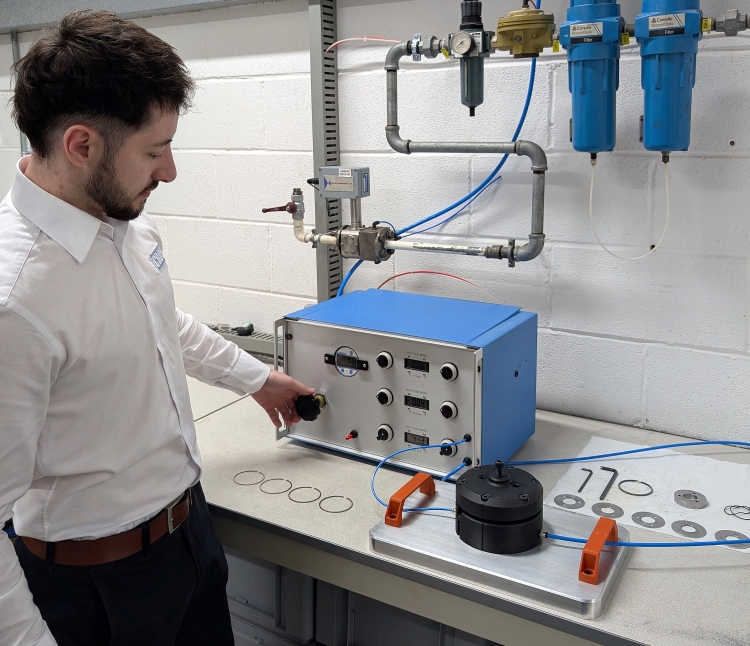
To run the tests, Cross engineers developed a new modular static test rig and precision control system, complete with switchable mass flowmeters and high accuracy pressure sensors. Repeatability tests showed less than 5% variation over ten full strip down cycles—an unusually high level of consistency for metallic sealing tests. The rig’s modularity means new geometries, materials and manufacturing tolerances can be evaluated in future studies.
A Cross Manufacturing spokesman explained the purpose of the tests: “With valves increasingly used in advanced high temperature applications where leakage limits are becoming ever tighter, the study raises the question whether the industry is underestimating what metallic rings can achieve.”
For further details a Cross White Paper titled ‘Metallic Sealing Rings for Valve Applications’ provides valuable insight for valve designers, system integrators, and engineering teams working in high temperature or safety critical applications. It can be viewed and downloaded from the Cross Manufacturing website.