Every forklift carries a capacity plate giving the maximum load it can safely lift. That figure assumes bare forks. Fit a drum handling attachment and the forklift can no longer safely lift what the plate says, which is why HSE guidance expects the truck to be re-plated before it goes back into service.
Working out the new figure is a job for your forklift supplier. What we can tell you is why the figure changes, and what to send them so they can calculate it.
Why a drum handling attachment reduces forklift capacity
Your forklift’s capacity plate gives a nominal figure, quoted at a stated load centre, usually 500mm in the UK and Europe. It assumes the load sits on bare forks. An attachment changes that in two ways:
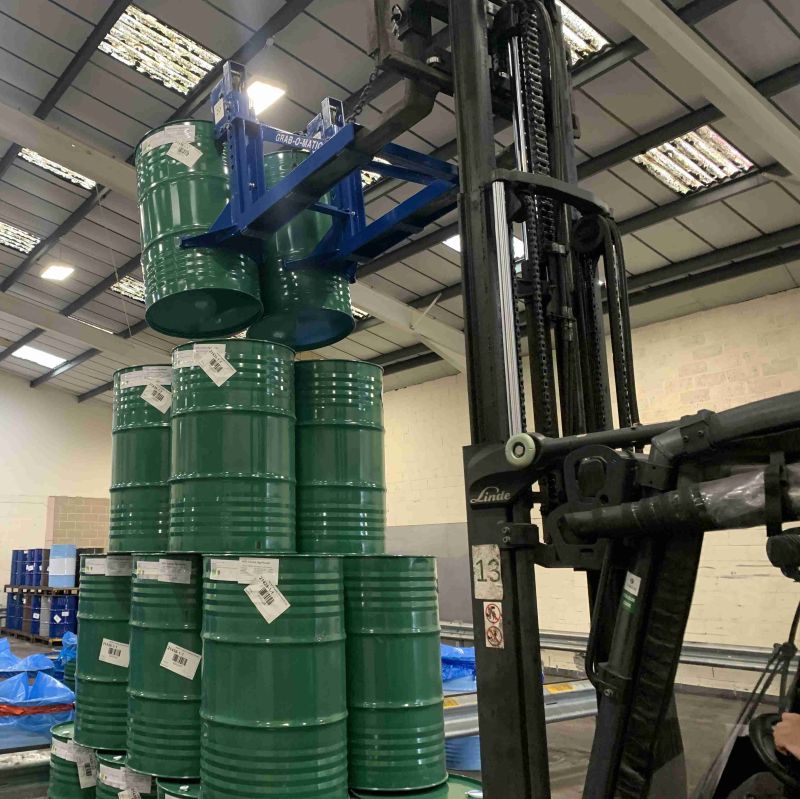
The attachment’s weight becomes part of the load. A drum handler weighing 115kg is 115kg the forklift is carrying before a drum is lifted, and it sits forward of the front axle where it works against the counterweight.
The load centre moves forward. This is the bigger of the two effects. A forklift works like a see-saw: the counterweight at the back balances whatever is on the forks at the front, and the further forward that load sits, the more leverage it has against the counterweight. An attachment holds the drum out beyond the fork face, so the same drum presses on the forklift’s balance considerably harder than it would sitting on bare forks. What matters is not the weight on its own, but the weight and how far out it is.
That’s why a forklift plated at 2,500kg on bare forks has less than 2,500kg available with a drum handler fitted, even though the attachment and its drums weigh a fraction of the plated figure. It is also why the working figure has to be calculated against the specific truck rather than estimated.
What HSE guidance says about derating and capacity plates
UK guidance is explicit about what happens when an attachment is fitted.
L117, the HSE Approved Code of Practice for rider-operated lift trucks, states at paragraph 100 that “fitting an attachment will require a reduction in the actual capacity of the lift truck, called derating”, and that “a new capacity plate relating to the attachment should be applied to the lift truck before it is used with the attachment”.
Before it is used, not at the next inspection. Alongside that, PUWER Regulation 4 requires work equipment to be suitable for the conditions in which it is used.
Making sure the forklift is safe to use is the employer's duty. Working out the revised figure turns on the truck's geometry and its manufacturer's capacity chart, so it is done by the forklift supplier or another competent person, and the new plate goes on before the attachment goes to work.
What your forklift supplier needs to calculate the derated capacity
Your forklift supplier will need figures from the forklift itself, from the drums you handle, and from the attachment. We can supply the attachment figures.
From the forklift: its plated capacity, its rated load centre, its fork length and carriage class, and the maximum lift height you work to.
From the drums: their type and their filled weight, which depends on what is in them.
From the attachment: its weight, load centre and overall dimensions. This is the information that we can supply. Each unit supplied By St Clare Engineering has the weight, capacity and load centre clearly marked on a label on the frame of the drum handler. These figures vary, for example with the addition of optional extras, or shorter or longer fork pockets, so you should always refer to the label attached to your specific unit. If your unit is old or you cannot read the label, simply contact us with the model and serial number and we will provide you with the correct information for their drum handler.
One point worth noting before you start. An attachment’s safe working load tells you what the attachment can hold, not what your forklift can lift while holding it. Both figures matter and they are not the same thing.
Before you specify a drum handling attachment
Have your forklift’s paperwork to hand: the capacity plate, the residual capacity chart from its manufacturer, and the lift height you actually work to. Your forklift supplier will want all three.
Know your drums. Type, size and filled weight all feed the calculation, and our guide to drum types sets out what each format needs.
Then ask us for the attachment figures. Tell us the model or the drums you handle and we will send you the weight, load centre and dimensions to pass on to your forklift supplier. Request the figures for your model.
Frequently asked questions about drum handling attachments and forklift capacity
Does fitting a drum handling attachment reduce a forklift’s capacity?
Yes. The attachment adds its own weight and holds the drum further forward than bare forks would, and both reduce what the forklift can safely lift. HSE guidance in L117 calls this reduction derating and expects a revised capacity plate on the truck before the attachment is used.
What does derating a forklift mean?
Derating means recalculating and reducing a forklift’s rated capacity to account for an attachment fitted to it. HSE’s Approved Code of Practice L117 states at paragraph 100 that fitting an attachment will require a reduction in the truck’s actual capacity, and that a new capacity plate should be applied before use.
Who works out the derated capacity of a forklift with an attachment fitted?
The forklift supplier or another competent person, because the calculation depends on the truck’s geometry and its manufacturer’s residual capacity chart. The attachment manufacturer supplies the attachment’s weight, effective load centre and dimensions as inputs. St Clare Engineering provides these figures for the Grab-O-Matic range.
Does a forklift need a new capacity plate after fitting a drum handling attachment?
HSE guidance says it should. L117 paragraph 100 states that a new capacity plate relating to the attachment should be applied to the lift truck before it is used with that attachment. The plate should reflect the derated figure rather than the original bare-fork capacity, and should be fitted by a competent person.
About the author
Andy Bow
Managing Director, St Clare Engineering
Andy Bow is Managing Director of St Clare Engineering Ltd, the sole worldwide manufacturer of the Grab-O-Matic range of drum handling forklift attachments. St Clare Engineering has been designing and building mechanical drum handling equipment at its Hampshire facility since 1959.