The Advanced Manufacturing show runs from the 2nd to 4th June 2015 at the NEC, Birmingham, UK.
Renishaw will be exhibiting a broad range of its innovative metrology and additive manufacturing products including the Equator™ gauge, AM250 - the only UK manufactured metal based additive manufacturing machine, the PH20 5 axis touch-trigger system for CMMs, a range of machine tool probe systems including the SPRINT™ scanning probe, as well as variety of styli and fixturing options.
Visitors to Hall 4 stand A125 will be able to see Equator, Renishaw’s lightweight, fast and highly accurate versatile gauge that operators can use with ‘push-button' simplicity. Equator's innovative flexible gauging technology is based for the comparison of production parts to a reference master part. Users can greatly increase throughput and reduce scrap rates at a fraction of the cost of an equivalent custom gauging system. New for Advanced Manufacturing is INTUO™ software, which simplifies and automates the gauging of a wide variety of parts, removing dependence on the skill of manual gauge users.
Also exhibited will be Renishaw’s AM250 laser melting machine. This system utilises a pioneering process capable of producing complex fully dense metal components direct from 3D CAD using a high-powered ytterbium laser. Parts are built from a range of metal powders that are fully melted in a tightly controlled atmosphere in a layer thickness ranging from 20 -100 microns.
5 axis touch-trigger measurement will be demonstrated by Renishaw’s PH20 system for co-ordinate measuring machines (CMMs). PH20 increases touch-trigger CMM throughput by up to three times, using fast, infinite rotary positioning and unique “head touch” capability for high-speed point capture with minimal CMM movement.
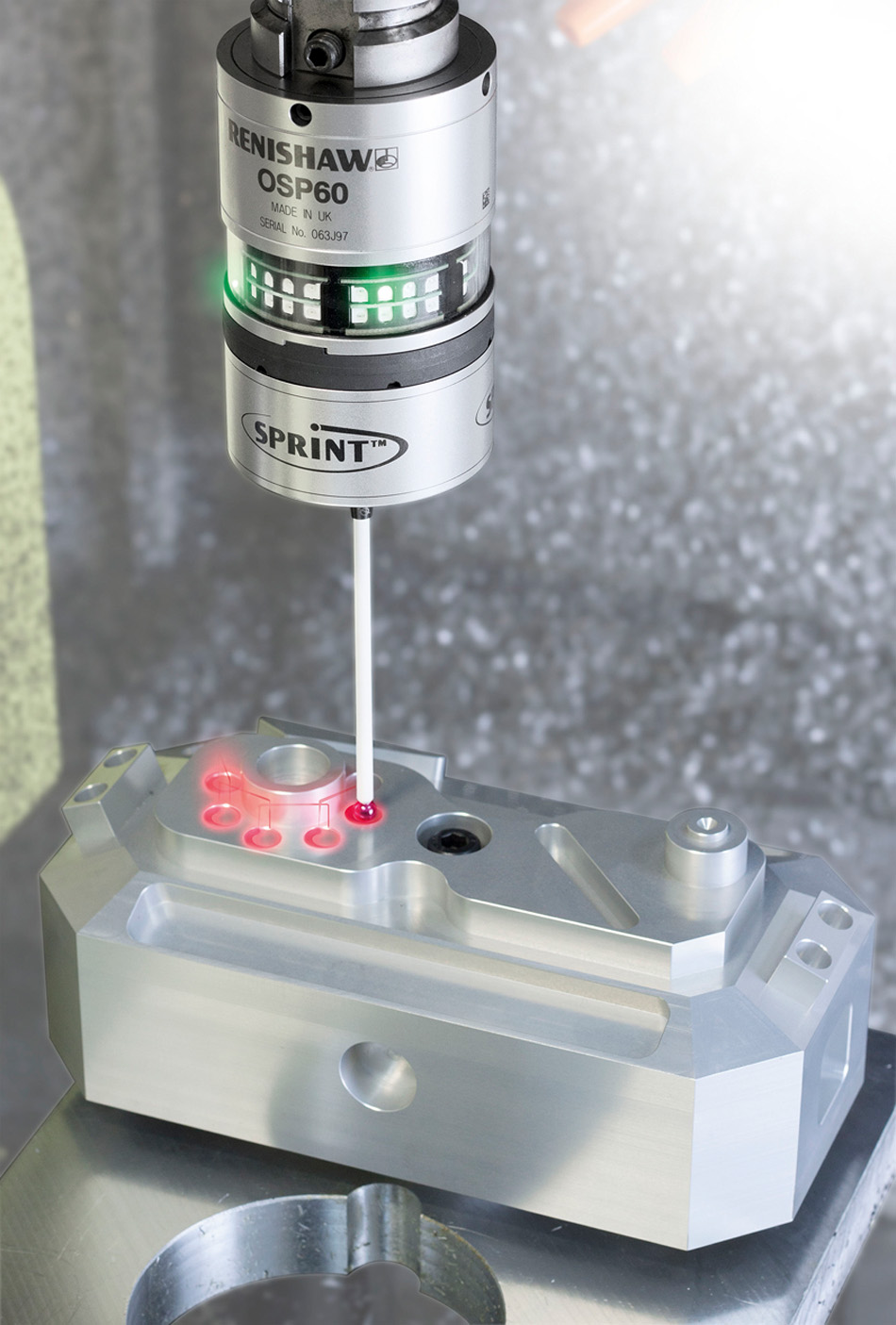
Visitors interested in process control for machine tools will also be able to discuss Renishaw’s game-changing machine tool probe system, SPRINT. The system incorporates a new generation of on-machine scanning technology that will deliver a step-change in the benefits of process control, enabling fast and accurate form and profile data capture from both prismatic and complex 3D components.